
Maryland's Mental Health Shortage: Why "Fast" Care Isn't Always Better Care
- Antoinette Goosby
- Jan 16
- 5 min read

Welcome back to our Maryland State of Mind series! If you missed Part 1 about the legislative landscape, you can catch up on the big picture. Today, let's talk about something that hits closer to home: what actually happens when you walk into a provider's office.
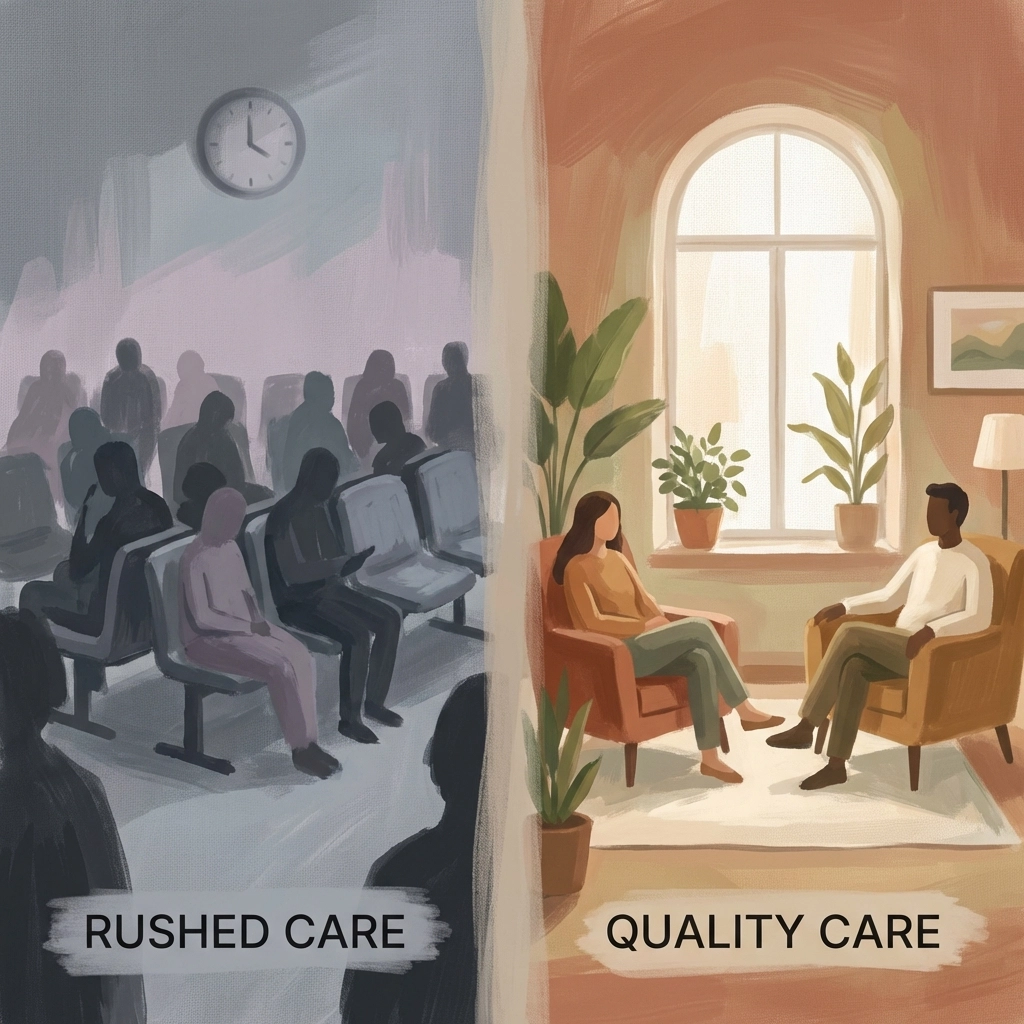
The 10-Minute Med Check Reality
Picture this: You finally get an appointment after waiting three months. You walk into a sterile office, answer a few rapid-fire questions about your mood, get your prescription adjusted, and you're out the door in 10 minutes. Sound familiar?
This isn't the provider's fault: they're drowning. With Maryland needing approximately 32,786 new behavioral health workers by 2028 and current supply meeting only half that need, many psychiatrists are seeing 40+ patients a day just to keep up with demand.
But here's the thing: when you're dealing with anxiety about starting your first "real job," postpartum depression that's making you feel like you're failing as a new parent, or ADHD that's derailing your college experience, a quick prescription adjustment isn't going to cut it.
Why Fast Care Falls Short for Young Adults
You know what I've noticed in my practice? Young adults (especially those 18-30) come in with layered, complex concerns that don't fit neatly into a 10-minute slot. You're not just dealing with "depression": you're navigating:
Identity shifts (Who am I outside of being a student?)
Life transitions (New job, new relationship, new city)
Cultural pressures (Social media, career expectations, financial stress)
Body image struggles (Especially common with new parents)
Imposter syndrome at work or school
When a provider rushes through these conversations, you leave feeling unheard. Worse, you might get a prescription that targets symptoms without addressing the root causes: which means you're back in three months with the same underlying issues.
The Hidden Cost of Quantity Over Quality
Here's something most people don't realize: Maryland actually put a moratorium on new Medicaid behavioral health provider enrollment through June 2026. Why? Because rapid expansion without quality safeguards led to providers "enrolling large numbers of clients and billing for services that were either never delivered, or delivered at such a low standard that they offered no therapeutic benefit."
The state's response? "We have enough quantity right now. We must focus entirely on quality and cleaning up the networks."
This tells us something important: even at the policy level, there's recognition that more isn't always better when it comes to mental health care.

What Quality Care Actually Looks Like
Quality psychiatric care: especially for young adults and new parents: should feel more like a collaboration than a transaction. Here's what I mean:
Time to Actually Talk You should never feel rushed. A good initial appointment takes 60-90 minutes, not 15. Follow-ups should be 30-45 minutes minimum. This isn't just about being thorough: it's about building the trust you need to be honest about what's really going on.
Holistic Assessment Your provider should be asking about your sleep, nutrition, movement, relationships, work stress, and life transitions: not just your symptoms. Depression doesn't exist in a vacuum, and neither do you.
Culturally Responsive Care This is huge, especially in Maryland's diverse communities. Your provider should understand how your cultural background, family dynamics, and social context affect your mental health. Cookie-cutter treatment plans don't work.
Integration of Different Approaches Here's where my background in dance movement therapy comes into play. Traditional psychiatry often focuses on thoughts and emotions, but your body holds trauma, stress, and anxiety too. Quality care integrates multiple modalities: medication when appropriate, therapy, movement, mindfulness: rather than defaulting to "here's a prescription, see you in three months."
The Body-Mind Connection You're Missing
Let me get personal for a second. As a student dance movement therapist, I've seen how much young adults and new parents benefit from approaches that honor the body-mind connection. When you're dealing with postpartum anxiety, for example, breathing techniques and gentle movement can be just as powerful as medication: sometimes more so.
But in a 10-minute med check, there's no time to explore how your body is holding stress, how movement might help regulate your nervous system, or how dance therapy could help you reconnect with yourself during major life transitions.

This isn't about replacing traditional psychiatry: it's about enhancing it. Research shows that integrative approaches often lead to better outcomes because they address the whole person, not just the symptoms.
Why Students and New Parents Need More
If you're a college student, you're not just dealing with "anxiety": you're learning how to be an adult while managing academic pressure, social dynamics, and future uncertainty. A quick prescription doesn't teach you coping skills or help you understand how your anxiety shows up in your body.
If you're a new parent, you're experiencing one of the most profound life transitions possible. Your identity, relationships, sleep, hormones, and daily routine have all been completely disrupted. You need a provider who understands that postpartum mental health isn't just about "baby blues": it's about integrating a massive life change while keeping yourself functional.
Quick fixes don't address these deeper transitions. Quality care does.
Finding Providers Who Get It
So how do you find quality care in Maryland's challenging landscape? Here are some practical tips:
Ask About Session Length If a provider can only offer 15-minute follow-ups, they're probably overwhelmed. Look for someone who can give you at least 30 minutes.
Inquire About Treatment Philosophy Do they believe in medication-only approaches, or do they integrate therapy, lifestyle changes, and other modalities? You want someone whose philosophy aligns with your needs.
Look for Cultural Competence Especially if you're from a marginalized community, ask how they approach cultural factors in treatment. Good providers will have specific examples of how they adapt their care.
Consider Telehealth Options Sometimes the best providers aren't in your immediate area. Telehealth can expand your options significantly.
The Bottom Line: You Deserve Better Than Fast
I know it's frustrating to wait for quality care when you're struggling. The shortage is real, and it's affecting everyone. But settling for rushed, superficial treatment often means you'll be cycling through the same problems months later.
Quality psychiatric care: the kind that honors your whole experience as a young adult, student, or new parent: is worth seeking out. It's worth waiting for. And it's worth advocating for.
Your mental health deserves more than a 10-minute conversation and a prescription adjustment. You deserve a provider who sees you as a whole person navigating complex life transitions, not just a collection of symptoms to manage.

The good news? Providers who prioritize quality care do exist in Maryland. They might be harder to find, and you might have to wait longer, but they're out there: working to address not just your symptoms, but your whole experience of being human in a complicated world.
Looking for more insights on holistic psychiatric care in Maryland? Check out our other posts on integrating movement with traditional psychiatry and what to expect from telehealth.
Comments